Friday, 15 May 2015

The Alarmist - RIP


Last night (Thursday 14th May, if you're reading this days after the event and are the most unreasonable kind of diary-keeping pedant) saw the launch party for the last ever edition of "The Alarmist". The passing of any good literary magazine is nothing to celebrate, but the death of an angular one with so much colour, wit, intelligence and accessible experimentation is particularly tragic. By combining brilliant, highly original short stories and poetry with humorous shaggy dog stories and biting bits of comedic verse, it was a reasonably left-of-centre literary journal and casual lunch-break reading dip combined. If there's another magazine out there doing something similar - at least in the English language - I'm not aware of it. Literary publications frequently suffer from an overload of pomposity, and "The Alarmist" replaced that with playfulness.

The front section of issue 5 is taken up with a large essay on how and why the magazine failed to last for more than two years, and it's well worth a read on their website if you've even the faintest interest in how independent literary magazines operate, or are thinking of starting one up yourself. If your ambition only stretches as far as producing a small black-and-white periodical with local distribution, it's probably not that relevant - but anyone who wants to attempt something bigger (or pull their small regional effort up to the next level) will probably learn a lot, or at least be forewarned about the pitfalls.

The regrettable lesson coming out of all this seems to simply be that the more ambitious you are, the more likely you are to fail. "The Alarmist" started out by giving away free artefacts such as poetry scratchcards - an utterly fantastic idea which is almost impossible to believe nobody's thought of before, until you get a sense of the scale of costs involved. Later issues just focussed on original design and striking content, and on that level the magazine really hit its stride around issue 4, which contained the most consistent stretch of stories, poems and artwork (lest anyone think I'm being biased about a magazine that published my work here, I didn't feature in issue 4 at all).

I'm occasionally asked why I don't start up my own literary magazine. The answer is simple. I don't have the time or money to do it myself, I don't believe that the magazine I would most enjoy producing would sell very much in an already deflated market, and I don't have a cohort of people willing to help me make it a workable venture (and that cohort extends far beyond people working to get the damn thing made and distributed, and into the realms of people willing to plug the damn thing on social media and elsewhere). But even if I did have a willing cohort of people, I probably still wouldn't have the time. The world is filled with writers hungry to get published somewhere - most magazines worth their salt get hundreds of submissions between issues - printers being an unreliable pain in the arse, bookshops not paying up on time, and poetry nights to sell your wares at. It's a big task to take on, and anyone who starts it with the best of intentions has my admiration.

The final "Alarmist" launch last night was odd to say the least, in that there was a poster outside 93 Feet East in Brick Lane advertising the poets on the bill - our names will probably never be emblazoned around Shoreditch again - and the terrifying comedian and winner of the Malcolm Hardee originality award Candy Gigi ended the night with aggressive audience participation and psychotic invective. But it suited the occasion, and was the most explosive finish everyone could have hoped for. If anyone wants to watch grown men being terrorised at high volumes by a barking wild-eyed woman with fruit, vegetables and cream, it's worth every minute. You probably won't even realise that you need to see this outside of the environs of the shit end of Walthamstow Market, but you do.

Anyway, buy issue 5. A poem of mine is in it. Then buy as many back issues as you can. Then please - go away and produce an interesting magazine yourself, no matter how much Gary and Mansour make you feel as if you shouldn't. 

Monday, 4 May 2015

The Alarmist - Issue 5 Launch - 14th May

I have some rather sad news to report. Issue 5 of literary magazine "The Alarmist" looks set to be the very last. For the last couple of years they have been producing a finely designed journal containing intriguing short stories and poetry. Each issue has been progressively more interesting than the last, but it would seem that the cost and effort of  keeping a full-colour specialist literary journal going has been a serious challenge.

I'll be performing at the launch for the final issue on 14th May, appearing alongside Candy Gigi, Evelyn Mok, Jay Cowle, Wesley Cooke, and Thomas McColl. It's £8 on the door if you want a copy of the magazine, £5 without. It's taking place at 93 Feet East on Brick Lane at 7pm, and the full Facebook details are here.

Hopefully we can all finish on a high. The line-up seems brilliant, and "The Alarmist" has discovered plenty of good names and given them a good kick to continue writing - let's get together and celebrate that, shall we? 

Friday, 20 March 2015

Two forthcoming appearances


Due to an enormous amount of other non-poetry related work in the pipeline, I've been very quiet on the live circuit of late. But...

I have two live appearances coming up very soon, and I'd be grateful if some of you could take this opportunity to drop by. Firstly, I'm doing a Feature spot at the Torriano on Torriano Avenue, Kentish Town, London, NW5 2SG on 19th April at 7:30pm. I'll be appearing with the excellent Amy Acre and Helen Moore, and floor spots will also be available. Facebook details, for those of you who do Facebook, are here: https://www.facebook.com/events/1550853345194825/ Everyone else, get your diaries out.

I'll also be helping Clare Saponia to launch her new book "The Oranges of Revolution" on 10th April at the Poetry Cafe, Betterton Street, WC2H 9BX, again at 7:30pm (https://www.facebook.com/events/942151585802826/) Both I and a number of other contributors will be reading from her book as well as delivering some poems of our own. You can also expect appearances from Helen Moore, Graham Buchan, Fatemeh Shams, SJ Fowler, Fran Lock, Wendy French, Benedict Newbery, Ceri May, Graham Bendel and Caroline Teague.

Clare says: "The collection addresses the Arab Spring, UK riots of 2011 and beyond. Above all, it’s about opening communication channels, vital to society's progression – hence the crew: their varied styles, voices, themes, thoughts and energies."

See you there. And hopefully this is the start of my gig diary starting to fill up a bit more again as I actually give it the focus it needs. Not many poets have agents, you know, and I'm no exception…

Incidentally, a question I get asked frequently by people who like what I do is "Why don't you do more readings/ performances?" The answer to that is "Well, I would if I was asked". I probably only turn down about 10% of the gigs I'm offered, and that's usually due to unavoidable clashes with other things in my diary. If you want to encourage bookings and support what I do, or indeed what any artist does, the simple answer is to do what all modern people have to do - talk about it online, tell people about it, spread the word. That's the way good promotion works these days - word of mouth. So if you like that struggling band, writer, comedian, artist or publication, talk about them. We need a campaign in this respect, I swear. Everyone is tweeting or talking about the same bloody things. If just 1% of everyone who tweeted about Jeremy Clarkson or Kanye West also tweeted about a poet each, we'd all be up and away.

Friday, 13 February 2015

This Blog Entry Is All About You


It's late spring, 1996. I'm live on stage playing a role in a rubbish university stage play I have co-written with a friend of mine, who I won't name to avoid shaming him. My friend had approached me initially with the idea of helping him to produce a 'black comedy'. In typical fashion, the 'comedy' aspect got lost about a tenth of the way through drafting the work, and my own political obsessions and particular brand of post-adolescent misanthropy slopped over the lot like steaming hot tar. (I'd like to take this opportunity to apologise to everyone who knew me back then, but that would be a waste of time, as I highly doubt any of them will be reading this).

Feeling inappropriately pleased with our work which featured, among other things, projections displaying phrases like "You are having a laugh", I drifted off home to have a few contented drinks in front of the television. Then the phone rang. On the other end was a friend of mine, with a very concerned and particular question.

"Dave," he asked. "The caretaker in that play… is that supposed to be me?"

The caretaker in the production was in a really short scene we wrote to bring light relief to an appallingly bleak piece of work. He was an ex-army soldier who spouted surreal observations which didn't bare much relation to the rest of the plot. The caretaker was not based on this particular friend, and it's beyond me why he thought he was.

"It's just, you see, I trained as a plumber, and he's fiddling with a radiator or something in the background…"

The bizarre reasoning continued.  I never did manage to convince him.

And of course, it's happened lots of times since. Even for a writer like me, without a book deal and with only the (increasingly) occasional live performance to my name, people will often approach me convinced they know "who" something is supposed to be about. All my friends who write suffer from the same problem.

It's an idle cliche that writers write about what we know, but unfortunately that's brought about the idea that we also take characters from real life and place them wholesale into our work too, often without giving a second's thought about how appropriate this might be or what purpose it serves. For what it's worth, these are my personal (until now) unwritten rules, for any kind of fiction:

a/ Leave your own family out of it.

There's a reason why, when you turn on Radio 4 to listen to poetry or biographical dramas, it's normally a non-English or quirky boho family you hear about - and that's because those are the only kinds of families who will usually tolerate their eccentricities being broadcast to a wider audience. Otherwise, it's frequently a very English trait to not want the illusion of familial normality to be shattered. If you're reading this at the moment and working on something that doesn't respect that, basing a character in your serious book entirely on your mad father or brother, I hope you're ready for carnage when it goes public. Don't say I didn't warn you.

b/ Never base characters on acquaintances you know and dislike.

Yes, Sarah from Accounts probably is a bitch, and I'm quite sure she's plotting against you to ensure that you lose your job, and that she deliberately failed to ask you to the pub after work but invited the rest of your team, and made a thinly veiled comment about your attire… but do you know what? While you're heavily emotionally invested in this stuff, it's truly tedious information to an audience. You probably know very little about Sarah's background, and what I want to hear about is why she behaves like this, what other relationships she has, what her disappointments and desires are. That's the information we'd have to flesh out to make her interesting, even make her funny, and you'd have to like her and know her - at least a bit - to communicate those details.

I once had a terrible job in a travel agents and worked with a "Sarah" type, who often said "I bet when you leave here you're going to write all about me, aren't you?" I never did, because there aren't many interesting things you can say about an acquaintance who is aggressive, humourless, difficult and moody seemingly for the sake of it, however cathartic spouting it all out may be. Except, of course, I've mentioned her just now. Whoops. (Blogs don't count).

c/ Similarly, unless there's a serious and genuine message to communicate, your relationship meltdown is of no interest to anyone.

Well, that may be a lie. I've watched a couple of young women win slams with what I consider to be awful "HE WAS A BASTARD BECAUSE HE DUMPED ME AND ANYWAY HE WAS TIGHT WITH MONEY AND PAID MORE ATTENTION TO HIS SISTER WHICH IS WELL WEIRD" poems, but that's usually because their friends are in the audience whooping away and getting busy with the ballots afterwards. Personally, I hear poems like that and my sympathies usually go out to the person the work was written about, whoever they are and whether they're male or female.

In general, though, poetry is a bit of a different area to fiction. We can afford to be a bit personal in poetry, although usually it will be sentimental love poetry we draft rather than bawling block caps hatred. But even in fiction, there's something truly, skin-crawlingly creepy about anyone who replicates their shouting bedroom dramas wholesale on to the page. It's beyond my imagining how much you'd have to hate someone to bring yourself to reproduce that stuff word for word for other people's entertainment.

d/ It's incredibly difficult to make a living from writing, so no piece of writing is ever worth losing the day job over.

Unless you want to be a whistleblower about some form of corruption, of course, in which case that's fine. But if you're just going to write a story about how grossly mismanaged your local pet shop is, and how it's run by a load of hamster-stinking oddballs who probably masturbate in the toilets at lunchtime while making the zebra finches watch, you shouldn't be that surprised if you no longer have a job in that pet shop in the morning. Though if the ideas I've put down there are anything to go by, you probably won't get the work published anyway.

So anyway, I think I've made my point in a very rambling fashion. Writers usually work with composites, and very, very rarely drop people they know from real life fully formed into their stories. I've even tried to actually drop a person (my wife) from real life into one of my stories, just for fun, and her character got completely changed in the redrafting process to fit the situation better, and I had to apologise and tell her she'd been more-or-less written out. Which didn't go down well either.

Hell, even poets writing about their latest love desire will change the place they first met from Wolverhampton to Ponders End if it suits the scansion and mood of the piece better, so you don't even get away with the facts and nothing but the facts there. Your dress was red when we met? Sorry darling, I've changed it to the colour green to avoid the inevitable Chris De Burgh comparisons. You're never going to get that flattering portrait exactly as you want it. It will always be a tiny bit fictional, a tiny bit not quite You.

And I suppose you're thinking "Well, he would say all this, wouldn't he?" And who knows, maybe you're right. Maybe you are indeed right. But you're not, you know. 

Friday, 19 December 2014

I Can't Believe It's Not Utter!


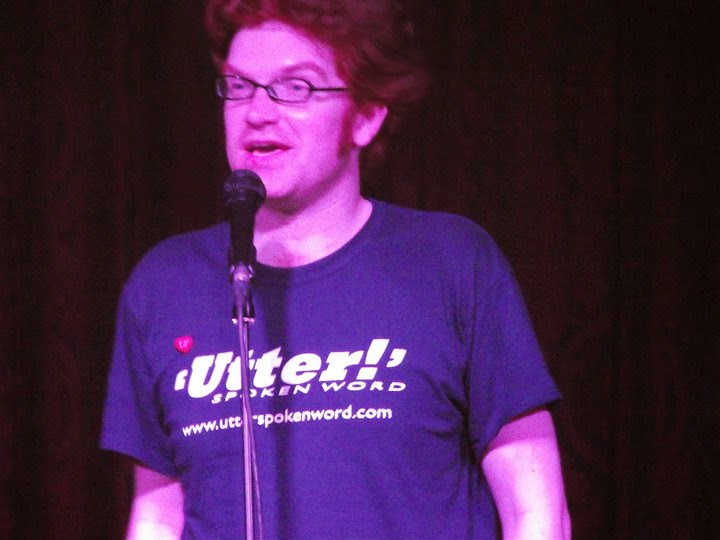
The final London "Utter!" went out in the Amersham Arms in New Cross on Tuesday night, finishing - thank God - on a bang rather than a whimper, with eighty witnesses in attendance on a soaking wet late December night. The epic slam format did an enormous amount to showcase the strengths of the evening, highlighting the sheer diversity of styles the evening promoted, from experimental to unashamedly populist back to oddball outsider again. Rather than catering for one style or demographic, "Utter!" at its best always illuminated the broad scope of the poetry circuit.

There's a write-up on "Write Out Loud" which pretty accurately describes the goings-on that night, as well as deservedly praising Richard Tyrone Jones's hosting techniques - he had an enthusiasm and a glint in his eyes I hadn't noticed for many months, as if he was absolutely delighted to be butchering his Arts Council funded event after ten years. Perhaps he was. Scratch that - he definitely was.

As we approach the end of the year and pick on the bones of 2014, it's going to be tempting for people to assume that the termination of both "Utter!" and "Poejazzi" mark the demise of a certain post-performance poetry way of doing things, both of these events being big-name nights in the confused hinterland of the mid-noughties. That, I think, would be a horrible mistake. "Poejazzi" remained  successful until the end, the line being drawn under its existence having rather more to do with the increasingly busy lives of the people who ran it than disappointing ticket sales. The audience levels at "Utter!", on the other hand, were usually not to be sniffed at for a mid-week poetry night out; the rooms just weren't as packed as they had been in its heyday. The days of the "Green Note" events in Camden where the room was so heaving it was sometimes impossible to get to the bar had disappeared (the Sylvia Plath and Ted Hughes puppet show remains fondly remembered by the many people who saw it).

The London Poetry circuit is, as I've stated before, run largely on favours, love and sometimes a tiny bit of a helping hand from the Arts Council. Most promoters fail in their ambitions to build a popular, branded poetry night, instead running an event for two or three years before exhausting themselves and dropping their plans after feeling the sting of a few ill-attended and perhaps marginally disorganised nights. A handful of promoters manage to develop a strong events team and take things a lot further, creating a night which captures the imagination of punters and generates both acclaim and funding - but, as yet, incredibly few of these nights have enjoyed more than four or five years of consistent high level popularity. There's a peak in media attention and audience attendance before a slow downwards trajectory occurs.

The reason for this is rarely that people tire of a format or a host, but rather that the host and the team behind the event just get a lot older and more exhausted. Promoting and maintaining high standards at a poetry night is thankless, almost always financially and sometimes on a personal level too. Amidst the occasional prima-donna and awkward artist they can also often find themselves dealing with poorly paid and inexperienced venue staff, difficult drunken punters and unreliable pub sound systems. And amidst all this, they're expected to effervescently host live poetry, an art form which, while it may be "on the up", is still not front page news and still requires hard work just to get more than a handful of people through the door. Without distributing flyers, tirelessly promoting the evening online and having a reliable team behind you, you can forget about a good attendance even if your evening is a "brand name".

This is why there's so much regular wastage on the London Poetry circuit, and why I feel as if I've watched so many brilliant, well-run nights disappear over the last fifteen years I've been a gig-goer here. Keen, confident poetry-lovers in their mid-twenties soon turn into thirty-somethings with children to feed and increasingly demanding day jobs to attend to. The post-room clerk with big ideas and a love of literature in 2003 becomes the team manager and father-of-two in 2013. The night becomes a chore rather than a joy. It gets promoted less. The bookings go into 'roster' mode. Attendances drop. The ghost gets given up on. So it goes.

Of course, while this is sad and it does feel as if the expertise of a lot of event organisers is being ditched (surely there should be somewhere else these people can take their knowledge and talents?), so long as other people are passionate enough - and stupid enough - to step into the fray to take their place, London will still have an envious array of poetry nights. And that also brings me on to my main point. If anyone is tempted to see the demise of "Utter!" as being significant, believing that there's no longer a place on the circuit for innovative, broad-reaching poetry nights, I'd urge them not to worry. Stick all your energy, belief and naive enthusiasm into it, and the people will come. Yes, there may be events on the circuit that attract younger, more photogenic audiences, but live poetry has an easy cross-generational appeal and if there are obvious gaps anywhere in the London market right now, it's for nights that offer a bit of what "Utter!" always did. Well hosted events with a diverse booking policy, a magazine show of all the best that live poetry has to offer, imaginatively themed and promoted. Take the baton and run with it, friends.

Farewell "Utter!" I'll miss you. It's been a brilliant ten years. But I look forward to seeing what the rest of you have to offer.

(Don't try to create a one-off evening that's anything like "Utter Shit!", though. That was a harsh lesson for Richard as a host and me as a DJ. People seemingly aren't keen on novelty themed nights of plastic poetry and poetry about shite things combined with novelty techno, glam rock and brass band versions of Beatles songs. Who'd have thought it? It remains the only time in my life I've ever managed to clear an entire venue as everyone fled to the front bar at the end.…)